Trump’s 2026 State of the Union: Painting a mirage of power
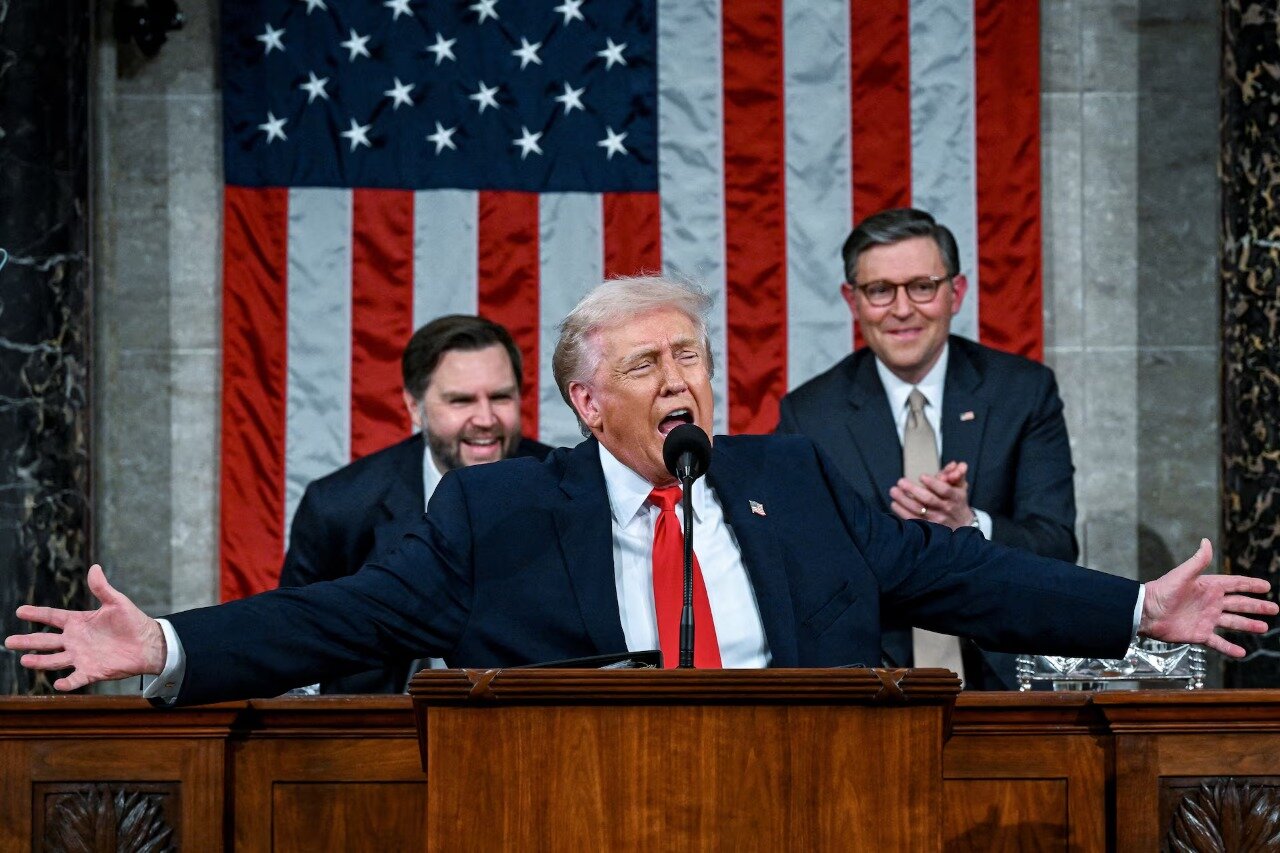
TEHRAN – In his 2026 State of the Union address, U.S. President Donald Trump delivered an extended narrative of American resurgence and foreign policy accomplishments. While the tone was confident and assertive, a factual review reveals that many of the president’s most dramatic claims were exaggerated, misleading, or unsupported by credible evidence. In particular, his discussion of conflicts abroad and military actions mischaracterized complex realities and overstated the United States’ influence and achievements.
Inflated claims about ending wars
A central theme of the speech was Trump’s claim that he had “ended eight wars” in his first year back in office. This assertion was repeated emphatically and framed as evidence of his unique effectiveness. Yet independent fact‑checking shows the claim does not stand up to scrutiny.
Many of the conflicts Trump listed were not formal wars with clear beginnings and endings.
Some were long‑standing disputes or diplomatic tensions, not armed conflicts, and others saw violence resume after temporary ceasefires.
There were no comprehensive peace treaties or enforceable agreements in most cases.
Calling diplomatic engagements, temporary pauses, or negotiated truces “wars ended” is a misleading simplification rather than an accurate reflection of international conflict resolution. This rhetorical exaggeration turns diplomacy into a dramatized victory, distorting the true state of world affairs.
Domestic policy exaggerations
Trump also overstated his achievements on the domestic front. He claimed that his administration had created a booming economy for all Americans and achieved record-low unemployment across every sector. In reality, while unemployment was low in some industries, wages remained stagnant for many middle- and lower-income workers, and job growth was uneven, leaving significant sectors struggling. On healthcare, he asserted that millions of Americans had gained better access under his policies, yet coverage improvements were limited, and many still faced rising insurance costs. On immigration, Trump declared the southern border “completely secured” and claimed illegal crossings had dropped to historic lows. Independent reports show that border crossings remained significant, enforcement was inconsistent, and humanitarian and asylum challenges continued, making his claims of complete success misleading.
The Iran narrative
Trump claimed that U.S. strikes in 2025 “obliterated” Iran’s nuclear sites and that Tehran was rebuilding its nuclear program, and developing missiles capable of striking the U.S. mainland. Independent reporting and fact-checks, show these claims were exaggerated. Iran has consistently maintained its nuclear program is for civilian purposes, and no evidence confirms it has weapons-grade ambitions. Damage from U.S. strikes was limited, missile capabilities are not an imminent threat to the U.S., and Tehran emphasized diplomacy, with officials stating a deal was “within reach.” Trump’s framing ignored these nuances, portraying Iran as far more threatening than facts support.
Venezuela and Maduro: Legal and ethical oversights
Trump used the capture of Venezuelan President Nicolás Maduro as another marquee foreign policy achievement. He presented the military operation as a decisive blow against tyranny. But a closer look shows: The operation involved the abduction of a sitting head of state, an extraordinary step that contradicts established international norms and raises legal and ethical concerns under the UN Charter.
Instead of acknowledging these concerns, Trump framed the action as unambiguously positive, omitting widespread debate about whether such interventions undermine international law and global stability.
By portraying this controversial action as a straightforward success, the address sidestepped legitimate criticism and failed to grapple with the broader implications of extraterritorial interventions.
Beyond wars, Iran, and Venezuela, Trump made additional claims that were factually overstated: He suggested dramatic improvements in global security, yet many conflict zones around the world remained volatile.
Hostage returns and ceasefire arrangements were depicted as watershed moments, when they were often incremental or part of ongoing negotiations.
Such framing gives the impression of complete, sweeping victories, which is inconsistent with the often slow and contested nature of diplomacy and conflict resolution.
Political narrative over factual accuracy
Across the speech, a clear pattern emerges: Trump presented selective narratives packaged as unequivocal success stories, while omitting qualifying evidence, dissenting analysis, or alternative perspectives. This approach helps build political momentum, but it weakens the factual credibility of his assertions.
Exaggerated language, absolute claims, and dramatic framing overshadow nuanced realities. Independent fact checks from international outlets and analysts consistently found that the greatest foreign policy claims in the speech — especially regarding Iran and wars ended — were not supported by verifiable evidence.
Trump’s 2026 State of the Union featured bold rhetoric and compelling claims about American strength and diplomatic prowess. However, when evaluated against independent reporting and factual many of those claims emerge as exaggeration or distortion. His portrayal of conflict resolution, military interventions, and global threats presents an oversimplified and inflated picture of U.S. influence and events.
By prioritizing grand narratives over careful reporting, the address functioned less as an accurate account of foreign policy and more as a political manifesto, raising important questions about truthfulness, accountability, and the role of fact in public leadership.
Leave a Comment